They Told Us the Taíno Were Extinct: Puerto Rico's History Under Two Empires
As a Puerto Rican, this history is not distant to me.
It is not simply a collection of dates, wars, laws, and dead political leaders. It is the history behind the word Boricua. It is the history beneath our language, our food, our music, our names, our faces, and the way Puerto Ricans have continued to survive no matter which empire claimed authority over the island.
For generations, many people were taught a simple story:
Christopher Columbus discovered Puerto Rico. Spain civilized it. The Taíno disappeared. And the United States eventually brought freedom and progress.
Almost every part of that story is incomplete.
Puerto Rico was not discovered. It was already inhabited.
The Taíno did not quietly vanish. They were conquered, exploited, displaced, and devastated, but they were never completely erased.
Spain did not simply settle an empty island. It established a colonial system through violence, forced labor, religious conversion, and control over Indigenous land.
And the United States did not liberate an independent Puerto Rico. It invaded one colony and took possession of it from another empire.
This is the history I believe more people need to know.
Before Puerto Rico Was Puerto Rico
Long before Europeans called the island Puerto Rico, Indigenous people knew it as Borikén, or Boriquén.
The people commonly described today as Taíno were not one perfectly uniform nation. The name refers broadly to Arawak-speaking Indigenous peoples who lived throughout Puerto Rico, Hispaniola, Cuba, Jamaica, and other parts of the Caribbean.
Long before European arrival, the Caribbean Sea connected Indigenous communities through travel, trade, family relationships, migration, and the exchange of ideas.
The Caribbean was not an empty collection of islands waiting for Europeans to give it history.
It already had civilizations.

Taíno communities lived in villages commonly called yucayeques.
Their societies included political leaders known as caciques and cacicas, who governed communities, formed alliances, organized labor, settled disputes, and exercised political authority.
Spiritual life was equally important.
Objects, ancestors, deities, and forces associated with zemí were deeply connected to Taíno understandings of the spiritual world, nature, ancestry, and political authority.
The Taíno cultivated crops including cassava, corn, sweet potatoes, peppers, squash, and peanuts.
They fished.
They hunted.
They made cotton textiles.
They produced pottery and carvings.
They traveled across the Caribbean using large dugout canoes.
They built ceremonial plazas and ball courts.
They created art from wood, stone, shell, bone, and clay.
They had families.
They had political systems.
They had religion.
They had agriculture.
They had trade.
They had history.
These were not people waiting for Europe to arrive and "civilize" them.
They already had a civilization of their own.
The Faces They Left Behind
Some of the most powerful evidence of the Taíno world is not found in a European document.
It was carved by Taíno hands.
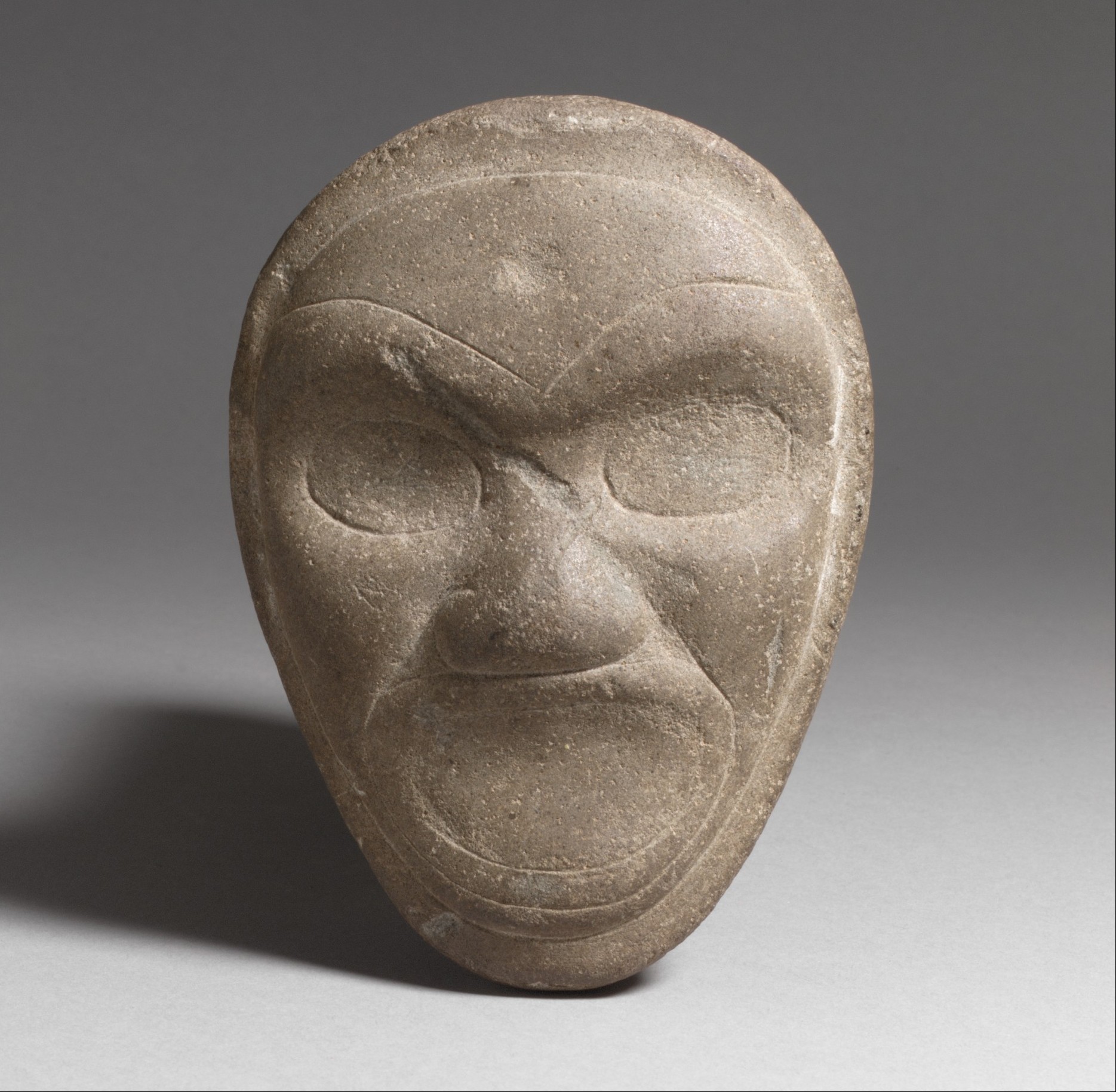
The object above comes from Puerto Rico and dates to approximately 1200–1500 CE.
The Metropolitan Museum of Art identifies it as a possible guaíza, a category of objects that could contain faces associated with zemí.
Look at it for a moment.
Not as an artifact from a dead civilization.
Not as something belonging only behind museum glass.
Someone carved that face.
Someone held it.
Someone understood what it meant.
Someone lived in a Puerto Rico that existed before Spain had any authority over the island.
That is the Puerto Rico we need to remember existed.
Spain Did Not Discover an Empty Island
Christopher Columbus reached Borikén during his second voyage in November 1493 and claimed the island for Spain.
Europeans may have been seeing Puerto Rico for the first time.
But Puerto Rico was not being seen for the first time.
Calling it a "discovery" automatically places the European observer at the center of the story while ignoring the people who were already living there.
Permanent Spanish colonization began in 1508 under Juan Ponce de León.
Spanish settlers were interested in land, gold, political power, and Indigenous labor.
Within only a few years, Indigenous people were being assigned to Spanish colonists through systems of compulsory labor.
Taíno workers were forced into gold mining and other forms of work that benefited Spanish settlers and the Crown.
Spain often presented these arrangements as systems through which Indigenous people would receive Christian instruction and protection.
In reality, these systems gave colonists control over Indigenous labor.
People were separated from their communities.
They were forced to work.
Their land was taken.
Their political structures were undermined.
Their religious traditions were attacked.
Their culture was pressured to conform to Christianity and Spanish colonial society.
The conquest of Puerto Rico was not only military.
It was political.
It was economic.
It was religious.
It was cultural.
And it was devastating.
The Taíno Were Not "Primitive"
Another part of colonial history that deserves to be challenged is the way Indigenous Caribbean societies were often portrayed as primitive.
Objects surviving from Puerto Rico show something very different.
This stone collar was carved from a single piece of stone.
The Metropolitan Museum of Art describes these objects as likely forms of regalia associated with caciques and public or private ceremonies.
Archaeological evidence suggests that many of these collars may have been produced around Caguana in Puerto Rico.
Think about the labor behind that.
The planning.
The craftsmanship.
The symbolism.
The knowledge passed from one generation to another.
The political meaning the object carried.
This was not a society without organization.
It was simply a society organized differently from Europe.
Different does not mean lesser.
The Taíno Fought Back
One of the most damaging misconceptions about Indigenous history is the idea that Native peoples simply accepted European conquest.
They did not.
The Taíno resisted.
In 1511, a major rebellion erupted against Spanish colonial rule, forced labor, and the seizure of Indigenous lands.
Resistance involved communities across different parts of Puerto Rico.
Indigenous leaders organized opposition against the colonizers, and fighting continued in different areas over a period of years.
Spanish forces responded violently.
Colonial military expeditions attacked resisting communities, destroyed villages and crops, captured Indigenous people, and attempted to break the ability of the Taíno to organize further resistance.
Women and children were not somehow separated from the consequences of conquest.
Entire communities suffered.
The destruction of food supplies meant hunger.
The destruction of villages meant displacement.
Forced labor removed people from their families and agricultural systems.
Warfare killed people directly.
Brutal working conditions killed others.
And European diseases entered Indigenous populations that had never previously encountered them.
The collapse of the Taíno population cannot honestly be blamed on disease alone.
Disease mattered enormously.
But so did warfare.
Forced labor.
Hunger.
Displacement.
Slavery.
Social disruption.
And colonial violence.
By the early sixteenth century, the independent political and social world of the Taíno in Puerto Rico had been catastrophically damaged.
That is how the Taíno world was broken.
It was not a mysterious natural extinction.
It was the result of colonization.
Their Spiritual World Was Attacked Too
Conquest does not only happen when one army defeats another.
A people can also be conquered by attacking the way they understand themselves.
Their language.
Their traditions.
Their religion.
Their ancestors.
Their stories.
Their identity.
Taíno spirituality existed long before Christianity reached Borikén.
The concept of zemí was connected with sacred and vital forces, ancestors, deities, political authority, and the natural world.
One of the most extraordinary surviving Taíno objects is this wooden ceremonial stand:
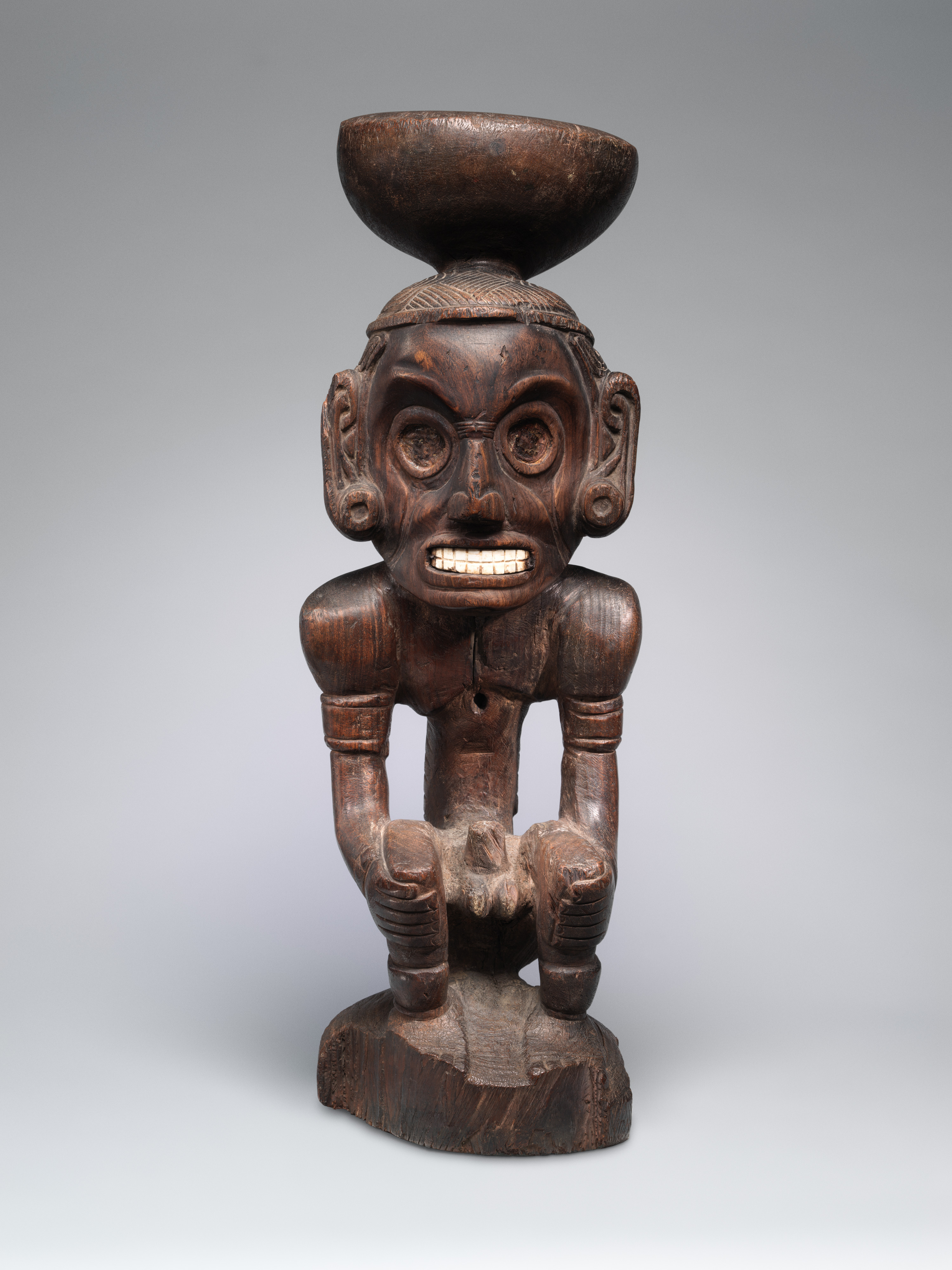
This object is roughly five hundred years older than the beginning of Spanish colonization of Puerto Rico.
It represents a spiritual world that Europeans did not create.
A religion Europeans did not invent.
A system of meaning that existed before Christianity was introduced to the Caribbean.
When Spanish colonization attempted to replace Indigenous beliefs with Christianity, it was not bringing religion to people who had none.
It was attempting to replace a religion that was already there.
That distinction matters.
So, Did the Taíno Really Become Extinct?
This is where the story many of us were taught becomes especially misleading.
For a long time, the Taíno were described as an extinct people.
That description is far too simple.
Spanish conquest devastated independent Taíno communities.
Their political institutions were destroyed or absorbed into colonial society.
Their population declined catastrophically.
Their traditional language eventually stopped existing as the everyday language of large, independent Taíno communities.
But that does not mean every Taíno person died.
Survivors remained.
Some escaped into more isolated areas.
Some joined other Indigenous communities.
Some were absorbed into colonial settlements.
Some formed families with Africans and Europeans.
Over generations, colonial authorities increasingly stopped identifying people as members of a separate Indigenous population.
Eventually, the disappearance of an official category became confused with the disappearance of the people themselves.
Those are not the same thing.
Modern genetic research has demonstrated Indigenous Caribbean ancestry among Puerto Ricans and other Caribbean populations.
Ancient DNA research has also identified genetic continuity between ancient Indigenous Caribbean populations and people living in the Caribbean today.
DNA cannot determine someone's entire cultural identity.
Having Indigenous ancestry does not automatically make someone culturally Taíno.
And modern Taíno identity is a subject with its own historical, cultural, and scholarly debates.
But the evidence makes one claim extremely difficult to defend:
The Taíno did not leave no descendants.
They did.
Today, people throughout Puerto Rico, the Dominican Republic, Cuba, the Virgin Islands, the mainland United States, and elsewhere identify with and work to recover Taíno heritage, culture, history, spirituality, language, and traditions.
Saying that the Taíno simply "went extinct" hides what actually happened.
Their society was devastated.
Their political independence was destroyed.
Their communities were scattered.
Their descendants mixed with other populations.
Their language was largely lost as a community language.
Their identity was suppressed.
But they were not completely erased.
Puerto Rico Under Spanish Rule
As Indigenous communities were devastated, Spain increasingly imported enslaved Africans into Puerto Rico.
Modern Puerto Rican culture developed through the interaction of surviving Indigenous people, Africans, Europeans, and people of mixed ancestry.
That mixture created something incredible.
But we should never romanticize it so much that we forget how much of it was created under conquest and slavery.
Puerto Rican culture was born from survival as much as it was born from cultural exchange.
Spain ruled Puerto Rico for roughly four centuries.
The island became strategically important because of its location in the Caribbean, especially as Spain attempted to defend its empire in the Americas.
Massive fortifications were constructed around San Juan.
But Puerto Rico was still a colony.
Political authority ultimately came from Spain.
Puerto Ricans did not possess independent control over their own country.
Government officials could be appointed from across the Atlantic.
Political participation was restricted.
Movements demanding reform, abolition, autonomy, or independence repeatedly challenged Spanish colonial authority.
The Grito de Lares
On September 23, 1868, Puerto Rican revolutionaries launched an uprising against Spanish rule known as the Grito de Lares.
The rebellion called for Puerto Rican independence and political freedom.
Revolutionaries proclaimed the Republic of Puerto Rico in Lares.
The uprising was defeated by Spanish authorities, but its importance did not disappear with the rebellion.
The Grito de Lares became a symbol of Puerto Rican resistance.
It proved that Puerto Ricans were not simply passive subjects who were perfectly satisfied living under Spanish colonial rule.
There were people willing to risk everything for a Puerto Rico governed by Puerto Ricans.
Slavery in Puerto Rico
Slavery remained legal in Puerto Rico until March 22, 1873.
Its abolition was an enormously important moment in Puerto Rican history.
But even abolition did not instantly create complete freedom.
Formerly enslaved people were initially required to continue working under labor arrangements designed partly to protect the interests of their former enslavers.
Again, Puerto Rican history shows us that governments can use the language of freedom while still preserving systems of control.
This pattern would not disappear when Spanish rule ended.
Puerto Rico Finally Receives Autonomy — And Then Everything Changes
After decades of political pressure, Spain granted Puerto Rico a degree of autonomy through the Autonomic Charter of 1897.
Puerto Rico began developing its own autonomous government.
On July 17, 1898, that government was formally inaugurated.
For the first time, Puerto Rico had received significant authority over its own internal government while remaining connected to Spain.
Then, only days later, everything changed.
The United States Invades Puerto Rico
On July 25, 1898, United States forces landed at Guánica, Puerto Rico, during the Spanish-American War.
American troops advanced across the island as Spanish resistance collapsed.
The war was not started over Puerto Rico, but Puerto Rico became one of the territories transferred as a result.
On December 10, 1898, Spain and the United States signed the Treaty of Paris.
Under Article II of that treaty, Spain ceded Puerto Rico to the United States.
Think about what that means.
Puerto Rico's political future was negotiated between Spain and the United States.
Puerto Rico was not an independent country sitting at the negotiating table deciding its own fate.
One empire surrendered possession of Puerto Rico to another.
The people living on the island did not collectively vote on the treaty.
They did not choose the terms.
They did not choose independence.
Puerto Rico was transferred.
Liberation or Another Empire?
Some Puerto Ricans initially welcomed American troops.
That matters too.
History should not be rewritten to pretend everyone reacted the same way.
Some people hoped the United States would bring democracy.
Some hoped for economic opportunity.
Some believed American rule might lead to greater freedom than Spanish colonial rule had provided.
Some may have believed independence would eventually follow.
Instead, Puerto Rico came under United States military government.
The island remained under military administration until 1900.
Spain was gone.
But Puerto Rico had not become independent.
One colonial government had been replaced by another political system controlled from outside the island.
The Foraker Act
In 1900, the United States Congress passed the Foraker Act.
It created a civilian government for Puerto Rico.
But that government was not fully controlled by Puerto Ricans.
The president of the United States appointed the governor and other major officials.
Congress retained enormous authority over the island.
Puerto Rico received a Resident Commissioner in Washington.
But the Resident Commissioner did not receive the same voting power as a full member of Congress.
Puerto Rico belonged to the United States.
But Puerto Rico was not a state.
And Puerto Ricans did not have equal representation within the government ruling them.
U.S. Citizenship — Without Full Political Equality
In 1917, Congress passed the Jones-Shafroth Act.
Among other reforms, the law granted United States citizenship to most Puerto Ricans.
This is another moment often simplified in history.
Citizenship sounds like political equality.
But Puerto Rican citizenship under the United States did not create equal political representation.
Puerto Ricans living on the island became United States citizens.
But United States citizens living in Puerto Rico still cannot vote for the president of the United States in the general election.
Puerto Rico elects a Resident Commissioner to Congress.
That commissioner can participate in congressional work and committees but cannot cast a final vote on legislation before the full House of Representatives.
Think about how strange that is.
A United States citizen from Puerto Rico can move to Florida, Arizona, Texas, or another state and vote for president.
That same citizen can move back to Puerto Rico and no longer vote for president in the general election because of where they reside.
Same citizenship.
Different political rights.
That is not equal representation.
Americanization
The United States also attempted to reshape Puerto Rican society through education.
English became a major focus of public education under American rule.
At different points, officials attempted to use English as the primary language of instruction in Puerto Rican schools.
American teachers were recruited.
The educational system became one of the tools through which government officials attempted to culturally integrate Puerto Rico into the United States.
But Puerto Ricans resisted complete linguistic assimilation.
Spanish survived.
Puerto Rican culture survived.
Puerto Rican identity survived.
The attempt to transform Puerto Rico culturally never completely succeeded.
The Ponce Massacre
Colonial violence did not end when Spain left.
On March 21, 1937, Puerto Rican Nationalists and others gathered in Ponce for a planned demonstration.
Police opened fire.
The event became known as the Ponce Massacre.
Twenty-one people were killed, including civilians, and many more were wounded.
A later civil-rights investigation concluded that the police action constituted a massacre.
It remains one of the darkest examples of political repression in modern Puerto Rican history.
People died in connection with a political movement centered around Puerto Rican nationalism and independence.
This was not something that happened under Spain.
This happened under American sovereignty.
La Ley de la Mordaza — The Gag Law
In 1948, Puerto Rico enacted Law 53, commonly called La Ley de la Mordaza, or the Gag Law.
The law became associated with repression of the Puerto Rican independence movement.
During this period, Nationalists and independence activists faced surveillance, raids, arrests, imprisonment, and government monitoring.
Puerto Rican nationalism could be treated not simply as a political disagreement, but as a potential threat to the government.
That history matters.
Because colonialism is not determined only by which flag hangs above a government building.
It is also about power.
Who makes the final decisions?
Who controls the territory?
Who gets representation?
Who can challenge the system?
And what happens when people demand something different?
The Commonwealth
In 1952, Puerto Rico adopted its own constitution and became officially known as the Commonwealth of Puerto Rico, or Estado Libre Asociado de Puerto Rico.
This gave Puerto Rico significant control over its local government.
Puerto Ricans elect their governor.
Puerto Rico has its own legislature.
Puerto Rico controls many internal affairs.
These are real powers and should not be ignored.
But Commonwealth status did not transform Puerto Rico into an independent country.
And it did not make Puerto Rico a state.
Puerto Rico remained a territory of the United States.
Congress retained significant constitutional authority over the island.
The fundamental political question was never truly resolved.
PROMESA
One of the clearest modern examples of that relationship came in 2016.
Facing a massive debt crisis, Congress passed the Puerto Rico Oversight, Management, and Economic Stability Act, better known as PROMESA.
The law created the Financial Oversight and Management Board for Puerto Rico.
The board was granted broad authority over Puerto Rico's finances, budgets, fiscal plans, and debt restructuring.
Supporters argued that the board was necessary to address Puerto Rico's financial crisis.
Critics saw something much deeper.
A government outside Puerto Rico had created an unelected board capable of exercising enormous power over the decisions of Puerto Rico's elected government.
Whatever someone believes Puerto Rico's political future should be, PROMESA demonstrated an uncomfortable fact:
Puerto Rico does not possess ultimate sovereignty over its political relationship with the United States.
Puerto Rico Still Has Not Resolved Its Status
Puerto Ricans continue to disagree about what the island's future should look like.
Some support statehood.
Some support independence.
Some support free association.
Some want to preserve or reform the current relationship.
These disagreements are real.
They exist within Puerto Rico itself.
And no honest history should pretend that every Puerto Rican believes the same thing.
This post is not meant to tell Puerto Ricans what future they must choose.
That decision should belong to Puerto Rico.
But whatever future is chosen should be chosen with an honest understanding of how we arrived here.
Puerto Rico Is Not Just a History of Suffering
When discussing colonization, slavery, invasion, political repression, and exploitation, there is a danger of presenting Puerto Rico as nothing more than a victim.
That would also be wrong.
Puerto Rican history is a history of survival.
The Taíno resisted Spanish conquest.
Indigenous ancestry survived the declaration that the Taíno were extinct.
Africans brought to the island through slavery preserved traditions, music, religion, food, and cultural practices that became inseparable from Puerto Rican identity.
Puerto Ricans rebelled against Spanish colonial rule.
Workers organized.
Political movements challenged American authority.
Communities preserved Spanish despite attempts at Americanization.
Artists created.
Musicians created.
Families survived.
People migrated and carried Puerto Rico with them.
Puerto Rican culture exists because generation after generation refused to disappear.
Borikén Is Still Here
Taíno influence is still embedded throughout Puerto Rico.
It survives in language, food, agriculture, place names, ancestry, and in the ways Puerto Ricans describe ourselves.
The word Boricua remembers Borikén.
Even after centuries of Spanish rule and more than a century under the United States, Puerto Ricans still call themselves by a name connected to the Indigenous island that existed before either empire arrived.
Our food remembers Indigenous, African, and European ancestors.
Our language remembers centuries of cultures colliding with one another.
Our music carries African rhythms, Spanish traditions, Indigenous memory, Caribbean influences, migration, poverty, resistance, celebration, and survival.
Our identity is complicated because our history is complicated.
Puerto Rico is Indigenous.
Puerto Rico is African.
Puerto Rico is European.
Puerto Rico is Caribbean.
Puerto Rico is Latin American.
Puerto Rico has been shaped by the United States.
And Puerto Rico is something entirely its own.
None of these truths require us to erase the others.
Why I Am Writing This
I am writing this because I am Puerto Rican.
And the more I learn about Puerto Rico, the more I realize how much of its history gets reduced to a few sentences.
I am not writing this because I hate Spanish people.
I am not writing this because I hate Americans.
People alive today are not personally responsible for everything governments and empires did centuries ago.
But honest history is not the same thing as inherited blame.
Refusing to discuss conquest, slavery, colonial rule, political repression, and unequal power does not create unity.
It creates ignorance.
I want Puerto Rican history to be remembered in full: the violence, the survival, the contradictions, the people who resisted, and the culture that endured.
Those truths should not disappear because they make people uncomfortable.
They Were Never Completely Erased
Maybe the part of this history that affects me the most is the sentence so many people were taught:
They became extinct.
That sentence is too small for what actually happened.
It turns conquest into disappearance.
It makes survivors invisible.
It reduces a living human history to an archaeological ending.
The Taíno world that existed before 1493 was devastated. Political independence was destroyed. Communities were broken apart. Language and religion were suppressed. Survivors were absorbed into a new colonial society.
But devastation is not the same thing as complete erasure.
Descendants remained.
Ancestry remained.
Words remained.
Foodways remained.
Memory remained.
And Borikén remained.
Puerto Rican history did not begin when Columbus saw the island.
It did not begin when Spain planted a flag.
It did not begin when American soldiers landed at Guánica.
And it did not become complete when one empire replaced another.
Puerto Rico existed before them.
Puerto Rico survived them.
And whatever Puerto Rico becomes in the future, its history belongs first to its people.
Borikén remembers.
Puerto Rico remembers.
And the people are still here.
Sources
Taíno History, Culture, and Archaeology
Smithsonian National Museum of the American Indian — Taíno: Native Heritage and Identity in the Caribbean
https://americanindian.si.edu/explore/exhibitions/item?id=966Smithsonian Institution — Indigenous Legacy in the Caribbean
https://www.si.edu/newsdesk/releases/indigenous-legacy-caribbean-featured-new-smithsonian-exhibitionNational Park Service — Taíno Life, Belief, and Ceremony
https://www.nps.gov/places/taino-life-belief-and-ceremony.htmNational Park Service — Indigenous Caribbean History at Salt River Bay
https://www.nps.gov/articles/saltriver.htmNational Park Service — Caribbean American Heritage and Archaeology
https://www.nps.gov/articles/000/archeology-this-month-caribbean-american-heritage.htmThe Metropolitan Museum of Art — Guaíza, Taíno, Puerto Rico, 1200–1500 CE
https://www.metmuseum.org/art/collection/search/312807The Metropolitan Museum of Art — Ceremonial Collar or Belt, Taíno, Puerto Rico, 1000–1495 CE
https://www.metmuseum.org/art/collection/search/893282The Metropolitan Museum of Art — Zemí Cohoba Stand, Taíno, ca. 1000 CE
https://www.metmuseum.org/art/collection/search/312602Wikimedia Commons — Caguana Indigenous Ceremonial Center
https://commons.wikimedia.org/wiki/File:Parco_Cerimoniale_Indigeno_di_Caguana.jpgWikimedia Commons — Caguana Indigenous Ceremonial Center Collection
https://commons.wikimedia.org/wiki/Category:Caguana_Indigenous_Ceremonial_Center

Taíno Resistance and Survival
EnciclopediaPR — Rebellion of the Taínos of Borikén, 1511
https://enciclopediapr.org/content/rebelion-de-los-tainos-de-boriquen-3-de-enero-de-1511/EnciclopediaPR — Puerto Rican Governors and Spanish Colonial History
https://enciclopediapr.org/content/cronologia-de-gobernadores-del-siglo-xvi/Cambridge University Press — Colonial Hispaniola and Indigenous Population Collapse
https://www.cambridge.org/core/books/islanders-and-empire/colonial-origins-hispaniola-in-the-sixteenth-century/ED24A60F0A6185AABFE609EAE26BC263Proceedings of the National Academy of Sciences / PubMed Central — Ancient DNA and Indigenous Caribbean Continuity
https://pmc.ncbi.nlm.nih.gov/articles/PMC5877975/Library of Congress — Taíno Language and Puerto Rico
https://guides.loc.gov/language-in-puerto-rico/taino-language
Spanish Colonial Puerto Rico
National Park Service — History of San Juan and Spanish Puerto Rico
https://www.nps.gov/saju/learn/historyculture/history.htmLibrary of Congress — Grito de Lares / Rebellion of 1868
https://www.loc.gov/collections/puerto-rico-books-and-pamphlets/articles-and-essays/nineteenth-century-puerto-rico/rebellion-of-1868/EnciclopediaPR — Abolition of Slavery in Puerto Rico, 1873
https://en.enciclopediapr.org/content/abolition-slavery-1873/EnciclopediaPR — Puerto Rico's Autonomic Charter of 1897
https://enciclopediapr.org/content/la-carta-autonomica-de-1897/
United States Invasion and Territorial Rule
U.S. Army Center of Military History — War with Spain and the Puerto Rico Campaign
https://history.army.mil/Research/Reference-Topics/Army-Campaigns/Brief-Summaries/War-with-Spain/U.S. Department of State, Office of the Historian — Treaty of Paris, 1898
https://history.state.gov/historicaldocuments/frus1898/d712aLibrary of Congress — U.S. Military Government in Puerto Rico
https://guides.loc.gov/world-of-1898/military-government-puerto-ricoU.S. House of Representatives Historian — Puerto Rico and Congressional Government
https://history.house.gov/Exhibitions-and-Publications/HAIC/Historical-Essays/Foreign-Domestic/Puerto-Rico/National Archives — Puerto Rican Records and the Jones-Shafroth Act
https://www.archives.gov/files/philadelphia/puerto-rican-records-guide.pdfU.S. House of Representatives — Structure and Representation in the House
https://www.house.gov/the-house-explainedLibrary of Congress — English Language and Education in Puerto Rico
https://guides.loc.gov/language-in-puerto-rico/english-language
Political Repression and Modern Puerto Rico
EnciclopediaPR — The Ponce Massacre
https://enciclopediapr.org/content/la-masacre-de-ponce/EnciclopediaPR — Nationalist Insurrection and Political Repression
https://enciclopediapr.org/content/insurreccion-nacionalista-1950/Library of Congress — Government Structure of the Commonwealth of Puerto Rico
https://blogs.loc.gov/law/2022/11/the-commonwealth-of-puerto-rico-and-its-government-structure/U.S. House Historian — Puerto Rico's Territorial Relationship with the United States
https://history.house.gov/Exhibitions-and-Publications/HAIC/Historical-Essays/Foreign-Domestic/Conclusion/U.S. Government Accountability Office — PROMESA and Puerto Rico's Financial Oversight and Management Board
https://www.gao.gov/assets/gao-25-108629.pdf
End transmission.