How Americans Were Taught to Fear Socialism, Trust Political Tribes, and Stop Questioning Power
There is something I want to say before anything else.
I am an anarcho-socialist.
I know what happens in the minds of some Americans as soon as they read those words.
Socialist.
Communist.
Marxist.
Authoritarian.
Anti-American.
Maybe even dangerous.
That reaction is part of the reason I am writing this.
I am not asking you to become an anarchist. I am not asking you to swear allegiance to socialism. I am not asking Republicans to become Democrats, Democrats to become Republicans, or anybody to trade one political identity for another.
I am asking you to do something far more uncomfortable:
Question what you were taught.
Because in America, we have spent generations learning to react emotionally to certain political words before stopping to ask what those words actually mean.
And when a population can be taught to fear a word before understanding it, whoever controls the meaning of that word gains enormous power.
The America We Were Taught About Never Really Existed
There is a version of American history repeated so often that many of us eventually stop recognizing it as an argument.
America was founded on capitalism.
Capitalism created America.
Capitalism equals freedom.
Socialism is foreign.
Socialism equals government control.
Communism is simply socialism taken to its inevitable conclusion.
It is simple.
It is memorable.
It is also a distortion of a much more complicated history.
To be clear, the founders of the United States were not socialists.
Private property, commerce, land ownership, markets and wealth accumulation were deeply embedded in early American society. So were slavery, enormous inequalities of political power and the violent seizure and distribution of Indigenous land.
But America was not founded as some sacred experiment in completely unrestricted laissez-faire capitalism either.
Alexander Hamilton's 1791 Report on Manufactures is a good place to begin.
Hamilton argued that the federal government could actively encourage American industry through protective duties and direct financial support. He called these subsidies “pecuniary bounties” and described them as an effective way of encouraging domestic manufacturing.
That matters.
One of the most influential members of America's founding generation was openly arguing that government could intervene in markets, protect domestic industries and use public resources to encourage particular forms of economic development.
That is not socialism.
But it is also not the mythology of a government that simply stood aside while an entirely free market built America.
Primary source — Alexander Hamilton, ***Report on Manufactures*****, 1791:** Founders Online — Read Hamilton's Report on Manufactures
Early American governments built postal infrastructure, imposed tariffs, supported transportation projects, distributed land and repeatedly intervened in economic development.
And even the phrase “public land” deserves scrutiny.
Land did not become available for American settlement because an empty continent was waiting to be developed. Federal expansion and land distribution occurred alongside the dispossession, removal and destruction of Native nations and communities.
The economic history of the United States is therefore far more complicated than:
capitalism = freedom = America.
Government power, private capital, public resources, markets, exploitation and collective investment have existed beside one another since the beginning.
You Already Live Inside a Mixed Economy
Here is where I think both defenders and critics of socialism often make the conversation unnecessarily easy to dismiss.
A road is not automatically socialism.
A public library is not automatically socialism.
A fire department is not automatically socialism.
Social Security is not, by itself, proof that America is socialist.
Political philosophers generally use socialism to describe economic arrangements in which major productive resources are placed under some form of social, cooperative, worker or democratic control.
The Stanford Encyclopedia of Philosophy describes socialism, at minimum, as involving social or democratic control over the bulk of the means of production.
It also makes an important distinction that Americans rarely hear:
Socialism does not automatically mean centralized state ownership.
There are socialist traditions involving worker cooperatives, decentralized ownership, democratic planning, markets and various mixtures of those systems.
Academic reference — Stanford Encyclopedia of Philosophy, “Socialism”: Stanford Encyclopedia of Philosophy — Socialism
So I am not going to tell you:
“Your fire department is socialism. Checkmate.”
That is an oversimplification.
The truth is more interesting.
America is a capitalist-dominant mixed economy containing enormous publicly financed and collectively administered institutions.
And Americans depend on those institutions constantly.
Social Security.
Medicare.
Medicaid.
Public schools.
Public universities.
Fire departments.
Libraries.
Roads.
Bridges.
Water systems.
Public parks.
Unemployment insurance.
Disability benefits.
Agricultural subsidies.
Federal disaster assistance.
Veterans' benefits.
Government-funded scientific research.
Public transportation.
Municipal utilities.
These institutions demonstrate something important about American life:
We already accept that markets alone should not determine the distribution of every resource necessary for society to function.
In fiscal year 2025, mandatory federal spending totaled about $4.2 trillion, according to the Congressional Budget Office. More than half of that spending went toward Social Security and Medicare.
Source — Congressional Budget Office: CBO — Mandatory Spending in Fiscal Year 2025
Social Security is an especially important example because it represents a fundamental political decision.
America decided that allowing millions of elderly people to fall into poverty simply because the market no longer valued their labor was unacceptable.
The original Social Security Act established federal old-age benefits, unemployment insurance and assistance programs for vulnerable Americans.
Source — National Archives: National Archives — Social Security Act of 1935
President Franklin D. Roosevelt signed the Social Security Act on August 14, 1935.
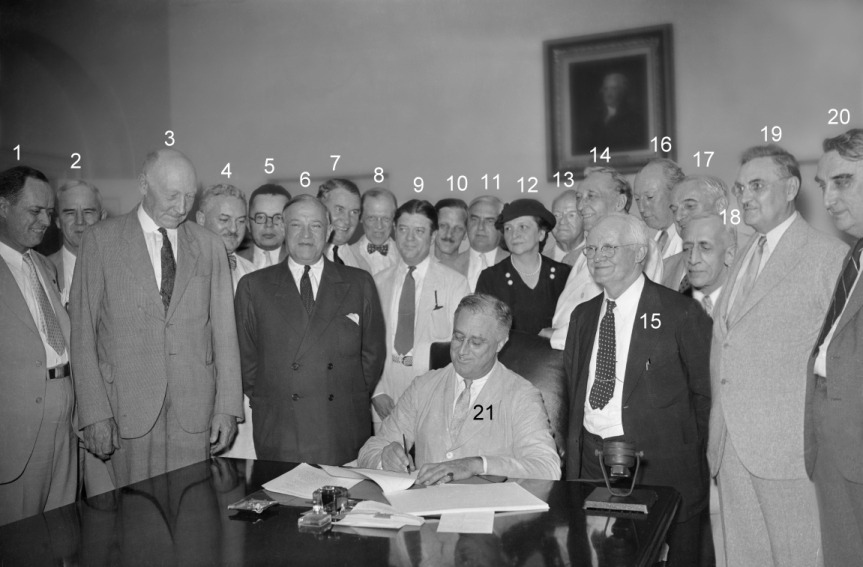
Social Security did not transform America into a socialist economy.
That is not the argument.
The point is that Americans already accept a principle commonly associated with socialist and social-democratic thought:
Society can collectively guarantee certain forms of economic security rather than allowing every outcome to be determined exclusively through private markets.
We often accept the principle.
We simply become uncomfortable with the vocabulary.
Socialism Is Not Communism
This may be the most important distinction in this entire article.
Socialism and communism are not synonyms.
There are Marxist socialists.
Democratic socialists.
Libertarian socialists.
Market socialists.
Syndicalists.
Mutualists.
Anarchist communists.
Anarcho-socialists.
Social democrats.
Worker-cooperative movements.
And many other traditions that disagree—sometimes profoundly—about markets, property, government, revolution, democracy and political authority.
There have also been authoritarian states that described themselves as socialist or communist while concentrating enormous power in centralized governments.
Those histories should not be ignored.
But treating every socialist philosophy as interchangeable with Stalinism is intellectually absurd.
It would be like claiming that liberal democracy, monarchy and fascism are the same political philosophy because all three have governments.
Even Martin Luther King Jr.—a man American culture often reduces to a handful of comfortable quotations about racial harmony—thought seriously about capitalism, socialism and communism.
In a 1952 letter to Coretta Scott, King wrote:
“I am much more socialistic in my economic theory than capitalistic.”
In that same letter, King also expressed serious philosophical disagreements with communism.
He was capable of criticizing capitalism without becoming a defender of authoritarian communist government.
Americans are capable of doing the same thing.
Primary source — Martin Luther King Jr. to Coretta Scott, 1952: The Martin Luther King Jr. Research and Education Institute — Letter to Coretta Scott
You can oppose authoritarian communism and oppose unrestricted capitalism.
You can support individual liberty and worker ownership.
You can distrust government bureaucracies and distrust corporations.
You can oppose political hierarchy and economic hierarchy.
That is precisely where many anarchist and libertarian-socialist traditions exist.
Why Does the Word “Socialism” Terrify So Many Americans?
That reaction did not appear out of nowhere.
America has a long history of anti-socialist and anti-communist political campaigns.
Again, historical honesty requires nuance.
The Soviet Union was an authoritarian state.
Soviet espionage was real.
The Cold War involved genuine geopolitical and military threats.
But the existence of those threats did not mean every socialist was a Soviet agent.
It did not mean every communist sympathizer was a spy.
And it certainly did not mean every labor organizer, musician, actor, professor or political dissident represented a national-security threat.
During the Red Scares, those distinctions repeatedly collapsed.
The official historical office of the U.S. House of Representatives describes how the House Un-American Activities Committee contributed to a “climate of domestic fear” through sensational and often unsubstantiated investigations.
That description does not come from an anarchist publication.
It comes from the United States House of Representatives itself.
Source — U.S. House of Representatives, Office of the Historian: House History — The House Committee on Un-American Activities
Decades of political rhetoric placed words like socialist, communist, subversive, radical and enemy beside one another.
Eventually, the distinction stopped mattering.
The word itself became frightening.
And frightened people rarely ask for definitions.
Emma Goldman and the Radical Idea of Questioning Everything
Emma Goldman remains one of the most important anarchist figures in American history.
She was controversial.
She was radical.
She opposed capitalism and compulsory state authority.
She defended labor organizing, reproductive freedom and freedom of expression.
She was arrested repeatedly and ultimately deported from the United States.
But one line from her writing captures something I believe is desperately missing from American political culture:
“Anarchism urges man to think, to investigate, to analyze every proposition.”
That is what anarchism means to me more than the cartoon image of chaos, destruction or someone throwing a bomb.
Question authority.
Question concentrated economic power.
Question government.
Question corporations.
Question political parties.
Question political movements.
Question your own side.
And question me.
If an ideology requires me to stop questioning it, I do not trust it.
I would say the same about a government calling itself socialist that I would say about a multinational corporation claiming that whatever increases shareholder value must automatically be good.
Power should have to justify itself.

Rights: Library of Congress catalog: “No known restrictions on publication.”
Library of Congress — Emma Goldman portrait recordThe importance of Goldman is not that everyone should agree with her.
The importance is the principle behind that sentence:
Never surrender your responsibility to think.
Propaganda Is Not a Conspiracy Theory
When people hear propaganda, they often imagine something almost cartoonish.
A secret government room.
A group of officials deciding exactly what every television anchor will say tomorrow.
Musicians receiving scripts from intelligence agencies.
Journalists following secret orders.
That is not how propaganda needs to work.
And we do not need conspiracy theories to establish that the United States government has used propaganda.
It openly has.
During World War I, President Woodrow Wilson's administration established the Committee on Public Information, or CPI.
One of its most remarkable programs was called the Four Minute Men.
More than 75,000 Americans delivered short, carefully vetted speeches in movie theaters, churches, union halls, parks and other public spaces encouraging support for the war effort and government programs such as Liberty Loans.
The Library of Congress estimates that their speeches may have reached audiences as many as 400 million times.
And the Library of Congress explicitly describes the program as a propaganda campaign.
Source — Library of Congress: Library of Congress — Four Minute Men and World War I propaganda

Rights: Library of Congress catalog: “No known restrictions on publication.”
Library of Congress — Four Minute Men poster recordThis was not secret.
It was government communications policy.
And governments did not suddenly stop trying to influence public opinion when World War I ended.
The technology changed.
Radio arrived.
Then television.
Then cable news.
Then the internet.
Then social media.
Then personalized recommendation algorithms capable of learning which subjects make individual people angry, frightened or emotionally engaged.
Government relationships with entertainment are also real and openly documented.
The Department of Defense maintains entertainment liaison offices that work with filmmakers and television productions seeking access to military personnel, locations and equipment.
The Defense Department says production agreements can include review of rough cuts when military assistance is involved.
That does not mean every military movie is propaganda.
But pretending no relationship exists between government institutions and entertainment would also be false.
Source — U.S. Department of Defense: Department of Defense — How and Why the DOD Works With Hollywood
Music has also been used intentionally as an instrument of American foreign policy.
Beginning during the Cold War, the State Department sent musicians including Dizzy Gillespie, Louis Armstrong and Duke Ellington abroad as Jazz Ambassadors intended to influence international perceptions of the United States.
Again, this is not a conspiracy.
The State Department openly describes it as cultural diplomacy.
Source — U.S. Department of State: State Department — Jazz Diplomacy: Then and Now
The lesson is not that every movie, song or news broadcast is secretly controlled by Washington.
That claim would be ridiculous without evidence.
The lesson is this:
Governments, corporations, media companies, political organizations and entertainment industries all understand that culture shapes what people believe.
Sometimes the influence is direct.
Sometimes it is indirect.
Sometimes it is ideological.
Sometimes it is commercial.
Sometimes nobody needs to issue an order at all because the financial incentives already point everyone in the same direction.
Fear Works
One reason fear appears so frequently in politics is brutally simple.
Fear works.
A major psychological meta-analysis examined 127 research papers containing 248 independent samples and more than 27,000 participants.
Researchers found that fear appeals can influence attitudes, intentions and behavior—particularly when the message also gives the audience a recommended response to the perceived danger.
Research — American Psychological Association: APA — Fear-Based Appeals Effective at Changing Attitudes and Behaviors
Think about how naturally that structure translates into politics.
First:
There is a threat.
Your family is in danger.
Your job is in danger.
Your neighborhood is in danger.
Your children are in danger.
Your country is in danger.
Your way of life is disappearing.
Then comes the second half:
Here is the person who can protect you.
Here is the party that can stop it.
Here is the policy you must support.
Here is the group you should blame.
Here is the person you should fear.
Here is who you need to vote against.
That mechanism does not belong exclusively to Republicans.
It does not belong exclusively to Democrats.
The target changes.
The psychological mechanism does not.
Terrorism: A Real Threat That Can Still Be Manipulated
Terrorism is real.
People have been murdered by terrorists.
Governments have a legitimate responsibility to prevent attacks.
Recognizing political manipulation does not require pretending real threats do not exist.
But a threat can be real and simultaneously presented in ways that distort our understanding of its prevalence.
Researchers examined American news coverage of terrorist attacks occurring between 2006 and 2015.
After controlling for factors including fatalities, arrests and the type of target attacked, incidents committed by Muslim perpetrators received an average of 357 percent more news coverage than other terrorist attacks.
That is an extraordinary disparity.
Research — ***Justice Quarterly*****:** Why Do Some Terrorist Attacks Receive More Media Attention Than Others?
Think about what repeated disproportionate exposure can do.
The media does not have to explicitly announce:
“You should fear Muslims.”
If one category of violence receives massively disproportionate attention, audiences may naturally begin overestimating its frequency.
That is why media literacy requires more than asking whether a particular news report is technically true.
We should also ask:
Why this story?
Why this headline?
Why this photograph?
Why this story every hour?
Why this framing?
Why these words?
And perhaps most importantly:
What equally important stories disappeared while I was watching this one?
Mexican Cartels, Immigration and the Power of Association
The same intellectual discipline should apply when politicians talk about Mexican cartels.
Mexican cartels are real.
They are violent.
They traffic drugs.
They kill people.
They should not be romanticized or minimized simply because politicians sometimes exploit the subject.
The Drug Enforcement Administration's 2025 National Drug Threat Assessment identifies the Sinaloa Cartel and Jalisco New Generation Cartel as major organizations involved in trafficking illicit fentanyl, methamphetamine and other drugs into the United States.
Source — U.S. Drug Enforcement Administration: DEA — 2025 National Drug Threat Assessment
But now watch what happens politically.
Cartel.
Drug trafficking.
Mexico.
Border.
Undocumented immigration.
Immigrant.
Crime.
Those separate categories can be blended together until millions of ordinary human beings become psychologically associated with violent organized crime.
That is where facts begin giving way to fear.
Peer-reviewed research using data from all 50 states and Washington, D.C., from 1990 through 2014 found that increases in undocumented immigration did not produce increases in violent crime.
The relationship was generally negative, although not statistically significant in every model.
Research — Criminology / National Library of Medicine: Does Undocumented Immigration Increase Violent Crime?
Another study used Texas Department of Public Safety data covering 2012 through 2018.
The researchers found that undocumented immigrants had substantially lower felony arrest rates than U.S.-born citizens for violent crime, property crime and drug offenses.
Research — Proceedings of the National Academy of Sciences: Comparing Crime Rates Between Undocumented Immigrants, Legal Immigrants and U.S.-Born Citizens in Texas
That does not mean undocumented immigrants never commit crimes.
They do.
American-born citizens commit crimes too.
The meaningful question is whether isolated crimes are being presented as evidence about an entire population.
There is an enormous difference between:
“This person committed a crime.”
and
“These people are criminals.”
Political fear depends on convincing us to forget that difference.
The Media Is Not One Giant Brainwashing Machine
There is another misconception worth correcting.
I used to think America's media problem could simply be described as people believing whatever “mainstream media” tells them.
The evidence suggests something more complicated.
Americans increasingly consume different media ecosystems.
Pew Research Center found large partisan differences in which news organizations Americans used during the 2024 election.
For example, Republicans were much more likely than Democrats to use Fox News and conservative talk radio, while Democrats were substantially more likely to use CNN, MSNBC, NPR, The New York Times and The Washington Post.
Research — Pew Research Center: Pew Research Center — Where Americans Turn for Election News
So the problem is not that everyone is hypnotized by the same television network.
It may be more dangerous than that.
We increasingly inhabit different political realities.
One person sees evidence proving Republicans are destroying America.
Another sees evidence proving Democrats are destroying America.
Each has commentators.
Each has clips.
Each has statistics.
Each has villains.
Each has scandals.
Each has algorithms constantly learning which stories will keep that person scrolling.
And rage is extremely good at keeping people scrolling.
Red Versus Blue Is a Very Expensive War
This is where I become deeply skeptical of both major parties.
Let me make something clear before somebody deliberately misunderstands what I am saying.
Democrats and Republicans are not identical.
Their policies can produce genuinely different outcomes.
Those differences can affect abortion rights, taxation, labor law, environmental regulation, immigration enforcement, healthcare, LGBTQ rights, gun policy, judicial appointments and countless other areas of people's lives.
Pretending those differences do not exist would be dishonest.
But acknowledging them does not require believing that America's two-party political system reliably serves ordinary people.
Both parties operate inside the same extraordinarily expensive political machine.
During the 2023–2024 federal election cycle:
Presidential candidates raised approximately $2 billion.
Congressional candidates raised approximately $3.8 billion.
Political parties received approximately $2.7 billion.
Political action committees raised approximately $15.7 billion.
Independent expenditures totaled approximately $4.4 billion.
Those numbers come from the Federal Election Commission.
Source — Federal Election Commission: FEC — Statistical Summary of the 2023–2024 Election Cycle
Think about the ecosystem created by that kind of money.
Candidates need fundraising.
Political parties need fundraising.
Political consultants need campaigns.
Lobbying organizations need access.
Media companies sell political advertising.
Advocacy groups solicit donations.
Super PACs raise enormous amounts of money.
Corporations and wealthy individuals seek political influence.
This does not prove that every politician secretly entered government because they wanted money.
Human motives are more complicated than that.
Some politicians undoubtedly believe strongly in what they are doing.
But the system itself rewards people who can attract money, attention, outrage and loyalty.
And those incentives matter whether the politician's campaign signs are red or blue.
Who Actually Has Political Power?
One influential political-science study tried to answer that question empirically.
Researchers Martin Gilens and Benjamin Page examined 1,779 policy outcomes and compared them with the preferences of average Americans, affluent Americans and organized interest groups.
Their analysis concluded that economic elites and organized business interests had substantial independent relationships with U.S. policy outcomes, while the independent effect of average citizens' preferences became extremely small once other factors were considered.
Research — Cambridge University Press, ***Perspectives on Politics*****:** Gilens and Page — Testing Theories of American Politics
That study has generated scholarly debate, and it should not be treated as the final word on American democracy.
But the question it raises deserves serious consideration:
Who has more practical access to political power—the person who casts one ballot every few years, or an organization capable of spending millions of dollars influencing elections and legislation?
That should bother Republicans.
That should bother Democrats.
That should bother socialists.
That should bother libertarians.
That should bother anybody who believes government should represent ordinary people.
The Two Parties Benefit From Fear of Each Other
There is a strange dynamic at the heart of American political life.
Republicans need Democrats to appear terrifying.
Democrats need Republicans to appear terrifying.
That does not require both parties secretly meeting in the same room and planning the arrangement.
No conspiracy is necessary.
The incentives already exist.
Political scientists use the term affective polarization to describe something that has become increasingly visible in American politics:
People are not simply disagreeing with the opposing party.
They increasingly dislike and distrust the people belonging to it.
A major review of the research described growing partisan hostility in which Republicans and Democrats increasingly view supporters of the opposing party as selfish, hypocritical and closed-minded.
Research — ***Annual Review of Political Science*****:** The Origins and Consequences of Affective Polarization in the United States
That transforms politics.
A campaign no longer needs to convince you:
“We will materially improve your life.”
It can instead tell you:
“Whatever problems you have with us, imagine what will happen if THEY win.”
Fear becomes loyalty.
Loyalty produces votes.
Votes produce power.
Power attracts money.
Money finances another election.
And the machine continues.
Meanwhile, Ordinary People Fight Each Other
This may be the most tragic part.
A working-class Republican and a working-class Democrat may despise each other while both are struggling to pay rent.
Both may worry about medical bills.
Both may worry about retirement.
Both may watch groceries become more expensive.
Both may work for companies where they have almost no influence over major decisions.
Both may have children who cannot afford homes.
Both may be one medical emergency, layoff or major repair away from financial disaster.
Yet they are encouraged to see each other as the enemy.
Red versus blue.
Urban versus rural.
Citizen versus immigrant.
Religious versus secular.
Conservative versus progressive.
Worker versus worker.
Neighbor versus neighbor.
And while ordinary people fight horizontally, economic and political power continues concentrating vertically.
One of the most effective political tricks imaginable is convincing ordinary people that the greatest threat to their lives is the person living down the street with a different bumper sticker.
What Anarcho-Socialism Means to Me
When I describe myself as an anarcho-socialist, I am not asking for the Soviet Union.
I am not asking for Stalin.
I am not asking for a dictator.
I am not asking for an all-powerful federal government controlling every business, every home and every human decision.
The anarchist part of my political philosophy begins with skepticism toward concentrated authority.
That includes state authority.
But I do not understand why that skepticism should magically disappear when the authority becomes privately owned.
If one government official having enormous unchecked control over thousands of people's lives is dangerous, why should I automatically trust a billionaire, corporation or financial institution with similar power?
Why is political domination considered tyranny while economic domination is often treated as simply the natural order?
The socialism I am interested in asks questions like:
Why shouldn't workers have meaningful influence over workplaces they make function?
Why shouldn't communities have greater control over resources necessary for their survival?
Why should essential healthcare primarily function as an opportunity for extracting profit?
Why should democratic participation end when somebody walks through the doors of their workplace?
Why do we proudly insist that political rulers should be accountable to the people they govern while accepting workplaces in which the people doing the labor may have virtually no meaningful control over major decisions?
Why should enormous concentrations of economic power receive less scrutiny than enormous concentrations of government power?
For me, that is where socialism and anarchism intersect.
Liberty without economic domination.
Cooperation without authoritarianism.
Community without compulsory hierarchy.
You are completely free to disagree with that.
In fact, I would rather someone strongly disagree with an idea they actually understand than support or reject a caricature somebody else handed them.
I Don't Want You to Replace One Propaganda Machine With Another
This part matters.
Left-wing people are capable of propaganda.
Socialists are capable of propaganda.
Anarchists can become dogmatic.
Governments calling themselves socialist have committed atrocities.
Revolutionary movements have produced authoritarian governments.
People who share my political beliefs are capable of lying, manipulating evidence, excusing violence and treating loyalty as more important than truth.
I refuse to pretend otherwise.
If my political philosophy can survive only by hiding inconvenient facts, then it does not deserve to survive.
The answer to right-wing propaganda is not left-wing propaganda.
The answer to corporate propaganda is not state propaganda.
The answer is creating a population that becomes extremely difficult to manipulate.
People who read beyond headlines.
People who open the source.
People who check statistics.
People who know the difference between correlation and causation.
People willing to read arguments they disagree with.
People who distinguish immigrants from cartels.
People who distinguish Muslims from terrorists.
People who distinguish socialism from communism.
People who distinguish publicly funded programs from an entirely socialist economy.
People who can criticize capitalism without romanticizing authoritarian regimes.
People who can criticize government without worshipping corporations.
People who refuse to turn politicians into celebrities, prophets or saviors.
Those people are inconvenient to every institution that depends on unquestioning loyalty.
Before You Give Someone Your Fear, Ask What They Want in Return
When a politician tells you to be terrified, ask what they want you to support because of that fear.
When television shows you the same horrifying crime for three consecutive days, ask whether you are watching a genuine statistical trend or an emotionally powerful individual case.
When somebody says socialism, ask them to define it.
When somebody says capitalism, make them define that too.
When somebody tells you America has always practiced pure free-market capitalism, read Hamilton.
When somebody tells you government propaganda could never happen in America, read about the Committee on Public Information.
When somebody tells you communism and socialism are identical, read political philosophy instead of memes.
When somebody tells you immigrants inherently bring violent crime, look at actual crime data.
When somebody tells you their political party represents ordinary people while the other represents corruption, look at the money flowing through the entire political system.
And when somebody—including me—claims to understand exactly how society should work:
Question them too.
You Are Not Required to Choose Between Red and Blue
You do not owe a political party your identity.
You are a human being before you are a Republican.
You are a human being before you are a Democrat.
You are a worker, parent, neighbor, friend, artist, student, builder, caregiver or simply somebody trying to survive before you are a demographic category on a campaign strategist's spreadsheet.
American political culture constantly demands that we choose between two packages of beliefs.
Pick red.
Pick blue.
Then defend the package.
Mock the other tribe.
Fear the other tribe.
Vote against the other tribe.
Repeat.
I reject that.
My politics are not based on finding the correct group of powerful people who should be allowed to rule everyone else.
They are based on questioning why so few people possess so much power in the first place.
Government power.
Corporate power.
Media power.
Economic power.
Military power.
Political power.
Concentrated power deserves scrutiny regardless of the flag, logo, political party or ideology wrapped around it.
America Is Not Secretly Socialist — And That Is Not My Argument
I want to make this absolutely clear because I do not want the argument distorted.
The United States is not secretly a socialist country.
The United States is not communist.
The founding fathers were not socialists.
And every tax-funded institution is not automatically socialism.
America is primarily a capitalist economy.
But it is a capitalist economy surrounded, supported and stabilized by massive public institutions, regulations, subsidies, social-insurance programs and government investment.
That distinction matters.
Because the actual history destroys both myths.
The myth that capitalism alone built everything America has.
And the opposite myth that every useful government program proves socialism already runs the country.
Reality is more complicated.
America was built through markets and government intervention.
Private enterprise and public investment.
Capital and labor.
Competition and cooperation.
Individual achievement and collective infrastructure.
The economic system we inhabit was never created by one ideology operating alone.
Socialism Is Part of American History Whether We Like It or Not
Socialists are part of American history.
Anarchists are part of American history.
Labor radicals are part of American history.
Capitalists are part of American history.
Union organizers are part of American history.
Cooperative movements are part of American history.
So are enslaved people.
Indigenous nations.
Immigrants.
Industrialists.
Workers.
Corporations.
Government institutions.
Reformers.
Reactionaries.
Revolutionaries.
And millions of people who never fit comfortably into any ideological category.
American history is complicated because human beings are complicated.
Reducing all of that to:
capitalism good, socialism bad, communism evil, America perfect
is not history.
It is mythology.
And reducing the entire world to:
capitalism evil, socialism good
would be mythology too.
I do not want mythology.
I want people who are harder to manipulate.
Think Before You Fear
I want Americans to hear the word socialism without automatically seeing Stalin.
I want them to hear the word capitalism without automatically seeing freedom.
I want them to hear terrorist without assuming an entire religion is responsible.
I want them to hear cartel without mentally transforming millions of Mexican people or immigrants into criminals.
I want them to hear Republicans and Democrats accusing one another of destroying America and ask whether fear itself has become one of America's most valuable political currencies.
Most importantly, I want people to stop being afraid of questioning the systems they inherited.
Because freedom cannot simply mean choosing which powerful institution you are permitted to obey.
Freedom requires the ability to question power itself.
Government should have to justify its authority.
Corporations should have to justify their authority.
Political parties should have to justify their authority.
Economic systems should have to justify their outcomes.
And movements calling themselves socialist or anarchist should have to answer difficult questions too.
Emma Goldman wrote that anarchism urges people to think, investigate and analyze.
More than a century later, that may still be one of the most radical things an American can do.
Think.
Investigate.
Question.
Read the source yourself.
And never allow somebody else to decide which ideas you are too afraid to understand.
Sources and Further Reading
Socialism, Capitalism and Political Theory
Stanford Encyclopedia of Philosophy — “Socialism” Academic overview of socialism, capitalism, social ownership, democratic control and the considerable differences between socialist traditions. Read the Stanford Encyclopedia entry
America's Early Economic System
Alexander Hamilton — ***Report on Manufactures*****, 1791 — Founders Online / National Archives** Primary source documenting Hamilton's support for tariffs, subsidies and other federal efforts to encourage domestic manufacturing. Read Hamilton's Report on Manufactures
Social Security and Public Economic Institutions
National Archives — Social Security Act of 1935 Primary historical documentation of the creation and purposes of Social Security. National Archives — Social Security Act
Congressional Budget Office — Mandatory Spending in Fiscal Year 2025 Federal figures covering Social Security, Medicare and other mandatory expenditures. CBO mandatory-spending data
Social Security Administration — Signing the Social Security Act Historical record and photograph of the 1935 signing ceremony. SSA historical archive
Martin Luther King Jr.
Martin Luther King Jr. Research and Education Institute, Stanford University — Letter to Coretta Scott, 1952 Primary source containing King's discussion of capitalism, socialism and communism. Read King's letter
Anarchism and Emma Goldman
Library of Congress — Emma Goldman Portrait Archival photograph used in the article. Library of Congress Goldman record
Emma Goldman — Anarchism and Other Essays Primary-source collection containing Goldman's writings on anarchism, government, capitalism and individual freedom. Project Gutenberg — Anarchism and Other Essays
American Propaganda
Library of Congress — Four Minute Men Documents the Committee on Public Information's World War I propaganda campaign and its estimated audience. Library of Congress — Four Minute Men exhibit
Library of Congress — Four Minute Men Poster Archival record for the 1917 poster used in this article. Library of Congress poster record
The Red Scare and Political Fear
U.S. House of Representatives — History of the House Un-American Activities Committee Official congressional history discussing HUAC and the climate of domestic fear surrounding its investigations. U.S. House Historian — HUAC
Fear and Persuasion
American Psychological Association — Fear Appeals Meta-Analysis Research reviewing more than 100 papers and tens of thousands of participants examining whether fear-based persuasion changes behavior. APA — Fear-Based Appeals
Terrorism and Media Coverage
Kearns, Betus & Lemieux — Justice Quarterly Study of American terrorist attacks between 2006 and 2015 finding substantial differences in media attention depending on perpetrator religion. Read the study — Why Do Some Terrorist Attacks Receive More Media Attention Than Others?
Cartels, Immigration and Crime
Drug Enforcement Administration — 2025 National Drug Threat Assessment Federal assessment of major cartel organizations and drug-trafficking threats. DEA — 2025 National Drug Threat Assessment PDF
Light & Miller — Undocumented Immigration and Violent Crime Longitudinal analysis covering all 50 states and Washington, D.C., from 1990 to 2014. Read the study through the National Library of Medicine
Light, He & Robey — Crime Rates by Immigration Status in Texas PNAS study comparing arrest rates among undocumented immigrants, legal immigrants and U.S.-born citizens. Read the PNAS study through the National Library of Medicine
Media and Political Division
Pew Research Center — Americans' Election News Sources Research documenting large partisan differences in the news organizations Americans use. Pew Research Center — Where Americans Turn for Election News
Political Money and Influence
Federal Election Commission — 2023–2024 Campaign Finance Summary Official federal campaign-finance totals for candidates, parties, PACs and independent expenditures. FEC — 2023–2024 Election Cycle Statistics
Martin Gilens & Benjamin Page — “Testing Theories of American Politics” Influential study examining 1,779 policy outcomes and the relative influence of average citizens, affluent Americans and organized interests. Cambridge University Press — Gilens and Page study
Political Polarization
Iyengar, Lelkes, Levendusky, Malhotra & Westwood — Annual Review of Political Science Major review of research into affective polarization and growing hostility between Republican and Democratic voters. The Origins and Consequences of Affective Polarization in the United States
Government and Entertainment
U.S. Department of Defense — DOD and Hollywood Official description of the Defense Department's entertainment liaison programs and relationships with film and television productions. Department of Defense — How and Why the DOD Works With Hollywood
U.S. Department of State — Jazz Diplomacy Official history of U.S.-sponsored musical diplomacy during the Cold War, including the Jazz Ambassadors program. State Department — Jazz Diplomacy: Then and Now